Why Tampa's Storm Season Is So Hard on Retaining Walls
If you live in Tampa, you already know the pattern: long, hot afternoons that build into sudden downpours, sometimes several inches of rain in a single hour. Then come the tropical systems, where a day or two of steady rain can saturate the ground far beyond what a normal storm would do. That cycle repeats for months, and it puts every retaining wall on your property under real stress.
A retaining wall's job is to hold back soil. But soil is never just soil. It contains air, organic matter, and water, and when it gets saturated, it becomes dramatically heavier. Water also pushes outward on its own, a force engineers call hydrostatic pressure. During storm season, that pressure builds faster than most homeowners realize, and if the wall was not designed and built to manage water, the results can range from bulging and cracking to a full collapse. Understanding how that happens is the first step toward protecting your investment.
What Hydrostatic Pressure Actually Does to a Wall
Think of a saturated hillside as a slowly inflating balloon pressed against the back of your wall. Every gallon of water that cannot escape adds weight and outward force. Hydrostatic pressure retaining wall failures almost always follow the same pattern: water enters the backfill soil faster than it can drain away, the soil becomes heavy and unstable, and the wall begins to lean or bow outward. Once a wall leans even slightly, it loses some of its structural advantage, and the problem accelerates.
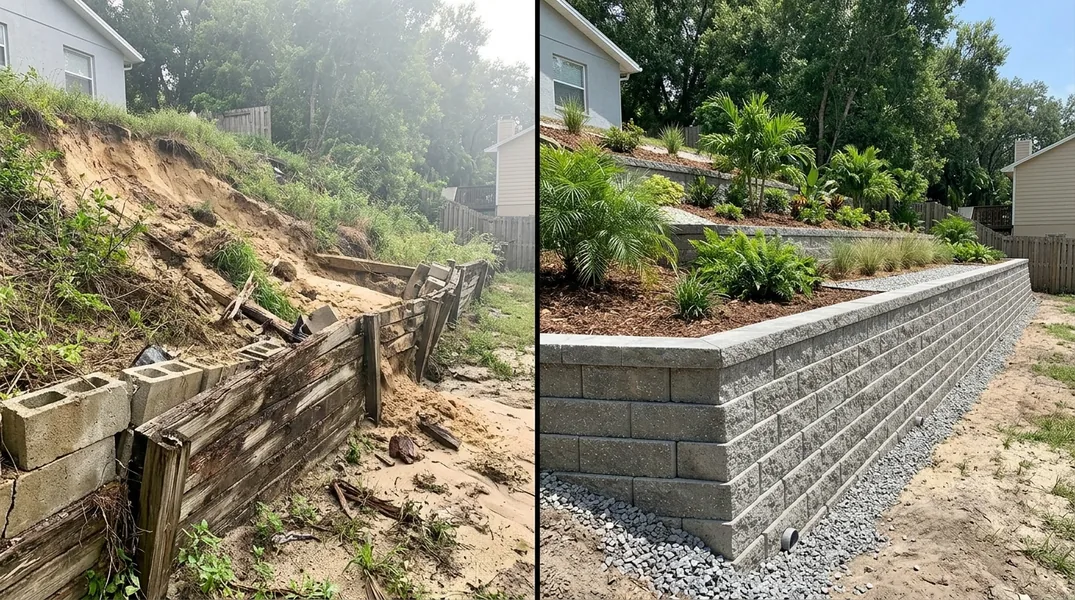
In Tampa, this often shows up as horizontal cracks, a wall that visibly tilts away from the hillside, or soil settling in front of the wall. You may also notice water seeping through joints long after the rain has stopped, which means water is trapped behind the wall. Left alone, that trapped water can undermine the footing and cause sections to shift or fail entirely. By the time a wall looks obviously damaged, the drainage problem has usually been building for years.
The Role of a Retaining Wall French Drain
The most reliable defense against hydrostatic pressure is a properly built retaining wall french drain. This is a perforated pipe placed in a gravel-filled trench along the base of the wall, on the uphill side, wrapped in filter fabric to keep soil from clogging it. Water flows into the pipe and is carried away from the wall instead of soaking into the backfill. A good system also includes a gravel drainage layer behind the wall and a way for water to exit at the low end of the wall.
Drainage details are easy to skip, and that is exactly why so many walls fail. A wall can look perfectly straight and solid on the day it is finished and still be a candidate for failure if the builder did not account for water. If you are planning a new wall, ask specifically how water will be managed behind it. If you already have a wall showing warning signs, a professional assessment can tell you whether the drainage can be improved or whether Retaining Wall Repair is needed to stabilize the structure.
Warning Signs Tampa Homeowners Should Not Ignore
Some drainage problems announce themselves loudly, and others are quiet until they are serious. Watch for a wall that leans or bows, cracks that widen over time, soil washing out from around the base, or water pooling behind the wall after storms. Efflorescence, that white chalky staining on concrete or block, is another clue that water is moving through the wall when it should be draining around it. Any of these signs deserve attention before the next storm season arrives.
It also helps to look at the ground above the wall. Soggy spots, sinkholes, or soil that has settled against the back of the wall all suggest water is not leaving the area. In a climate like Tampa's, where heavy rain is a certainty rather than a possibility, small drainage issues rarely fix themselves. Addressing them early is almost always less expensive than rebuilding a failed wall. If you are unsure what you are seeing, a free estimate and inspection can give you a clear answer.
Retaining Wall Installation Near Me: Getting Drainage Right From Day One
The best time to solve drainage is during construction. A properly designed wall accounts for the slope, the soil type, the expected water volume, and where that water will go once it leaves the wall. That means choosing the right materials, building a real french drain system, and backfilling with free-draining gravel rather than whatever soil is on site. Retaining Wall Installation done with drainage in mind will outperform a prettier wall built without it, every time.
Material choice matters too. Concrete Retaining Walls are a popular option in the Tampa area because they handle moisture well and hold up to heavy rain when paired with a solid drainage plan. If an existing wall has failed beyond cost-effective repair, Retaining Wall Replacement may be the practical path, and it is an opportunity to build the drainage system the original wall never had. Homeowners in nearby areas like St. Petersburg, Clearwater, and Brandon face the same storm-season pressures and should plan for drainage the same way.
If you want to know what a properly drained wall would involve for your property, reach out to Tampa Retaining Wall at (656) 254-3746 or request a free estimate. You can also review pricing to start planning your budget before storm season arrives.
Looking for a professional retaining wall contractor in Tampa? Tampa Retaining Wall responds fast for all your retaining wall needs.
Get a Free QuoteOur services: Retaining Wall Installation · Retaining Wall Repair · Retaining Wall Replacement