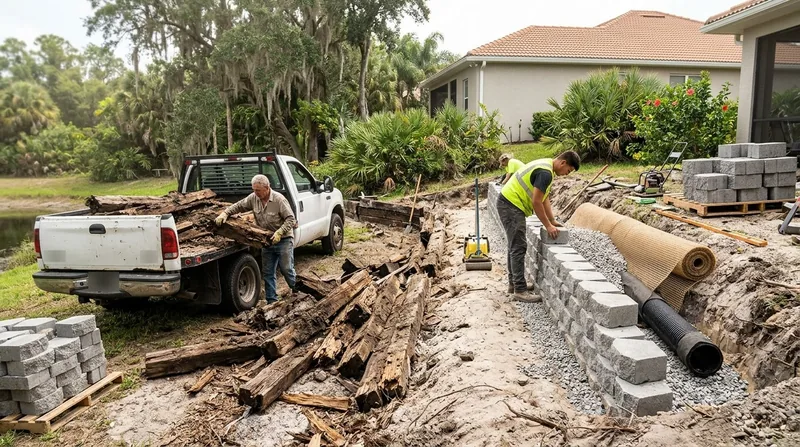




If you drive through Seminole Heights or along the Bayshore, you have seen them: clean, stacked block walls holding up a raised yard, a pool deck, or a driveway cut into a slope. Block & Segmental Retaining Walls in Tampa are the go-to solution for homeowners who want a durable, good-looking wall that can handle our sandy soil, high water table, and summer downpours. These mortarless systems, like Allan Block, Versa-Lok, and Keystone, use engineered geogrid to tie the wall back into the hillside, so they flex with the ground instead of cracking. Whether you are dealing with a failing timber border in Riverside Heights or need a new garden wall in Westchase, we build walls that stay put. For a broader look at how we approach every wall project, start with our retaining wall installation service page.
Why Block & Segmental Walls Make Sense in Tampa's Flat, Sandy Terrain
Tampa is mostly flat, low ground on sandy soil over porous limestone, with a water table that sits high near the bay and the Hillsborough River. That means water moves fast through the sand during summer storms and hurricane rain, and walls that are not built to drain will wash out or lean within a few seasons. Segmental block walls are ideal here because they are designed to flex and weep, not fight the water. They also handle the karst settling we see in older neighborhoods like Hyde Park and Palma Ceia, where the ground can shift under a heavy wall.
- Engineered geogrid reinforcement ties the block courses back into the soil, resisting overturning and sliding.
- Mortarless construction allows slight movement without cracking, which is critical in our expansive sandy soils.
- Integrated drainage (gravel, filter fabric, and weep holes) channels stormwater away from the wall face.
- Modular block comes in curves, corners, and caps, so it fits raised beds, pond banks, and garden walls.
- Freeze-thaw resistance is not a concern here, but UV stability and color retention are, and quality block holds up to the Florida sun.
If you are weighing block against other materials, our concrete retaining walls page explains when poured concrete is the better call.
Key info: In Davis Islands and along the Bayshore, we often replace failing timber walls with segmental block because the block system handles the high water table and boat wake vibration better than wood. One homeowner in Palma Ceia had a 3-foot timber wall that leaned after every summer storm; we swapped it for a Versa-Lok wall with geogrid and a French drain, and it has not moved since.
For official guidance on wall permits and construction standards, check the City of Tampa's building permit information at tampa.gov/construction-services.
How We Build a Block Wall That Lasts in Tampa
We start every segmental wall project with a site visit and a soil check. In Tampa, that means looking at drainage patterns, the slope, and what is uphill. We then design the wall with the right block, geogrid spacing, and drainage detail for your specific yard. Our crews are trained on Allan Block and Versa-Lok systems, and we follow the manufacturer's installation specs to the letter.
- We excavate and prepare the base. A compacted gravel footing is critical; we dig below the frost line (not an issue here) but down to stable soil and compact in lifts.
- We set the first course level. The entire wall depends on a dead-level base course, so we check it with a laser and adjust before locking in.
- We install geogrid as we stack. For walls over 3 feet, we lay geogrid every two to three courses, extending it back into the retained soil per the engineer's design.
- We build in drainage. A gravel trench, perforated pipe, and filter fabric behind the wall keep water from building up, which is the number one cause of failure in Tampa's sandy soil.
- We cap and clean up. We install the manufacturer's cap block, sweep the site, and walk you through the finished wall.
If your wall is on a slope or near a pond, we may recommend slope stabilization measures in addition to the wall itself.
Key info: In New Tampa and Westchase, many homes sit on raised pads beside retention ponds. We recently built a 4-foot Allan Block wall along a pond bank in Westchase; the wall had to be set back from the water and include a stone toe and geogrid to resist erosion. The homeowner wanted a clean look, so we used a charcoal block with a matching cap.
Block & Segmental Retaining Wall Approaches We Use in Tampa
Not every wall is the same, and the right approach depends on height, load, and access. Here is a quick comparison of the systems we install most often in the Tampa area.
| Approach | Description | Best for |
|---|---|---|
| Allan Block | Mortarless block with a pinless system and optional geogrid. | Curved garden walls, raised beds, and walls up to 4 feet. |
| Versa-Lok | Solid, heavy block with a built-in setback and geogrid options. | Taller walls, driveway retaining walls, and structural applications. |
| Keystone | Pin-connected block system with a range of face styles. | Walls with curves and corners, and where a specific look is desired. |
| Engineered Wall (with geogrid) | Block wall with geogrid layers designed by an engineer for taller or loaded walls. | Walls over 4 feet, tiered walls, or walls supporting a surcharge. |
We help you choose the right block and reinforcement based on your site, and we always follow the manufacturer's specs.
Block & Segmental Retaining Walls Cost in Tampa: What to Expect
Most segmental block walls in Tampa start around From $25 per square foot, but that number moves based on height, access, and engineering. A simple 2-foot garden wall in Temple Terrace will sit at the low end, while a 5-foot engineered wall with geogrid and drainage in Riverview will run higher. We factor in block type, excavation, base prep, drainage, and any permit fees. Getting two or three estimates is smart so you can compare scope, not just price. For a detailed breakdown, see our pricing page.
What to Look for When Hiring a Retaining Wall Contractor Near Tampa
Hiring the right contractor is the difference between a wall that lasts decades and one that leans after the first wet season. Start by verifying that the company is fully insured for work in Florida, and ask for a certificate of insurance. Get at least three written estimates that clearly state the wall height, block type, drainage details, and whether a permit is included. Check references from similar projects in your area, and ask if they have experience with the block system you want. If your property is in an HOA, confirm the wall style and color are approved before you sign. And remember that any wall over 4 feet, or one that supports a driveway or structure, likely needs a permit from the local building department.
To schedule a free on-site estimate, reach out through our contact page.
Block & Segmental Retaining Walls in Tampa: Pricing Guide
| Service | Price | Details |
|---|---|---|
| Garden wall (up to 3 ft high) | Starting at $25/sq ft | Includes standard block, base prep, and basic drainage; price rises with curves and tight access. |
| Engineered wall (4-6 ft high) | Starting at $40/sq ft | Includes geogrid design, gravel drainage, and permit handling; taller walls or surcharge loads cost more. |
| Tiered or terraced wall | On estimate | Multiple walls with setback require engineering and careful drainage planning; on-site review needed. |
| Travel | Included | in Tampa and surrounding areas, no separate call-out or mileage fee |
| Estimate | Free | Response within 24h at (656) 254-3746, no obligation to book |
Indicative pricing, the exact cost depends on square footage, finish, and site access. Free personalized estimate within 24h at (656) 254-3746.


